Wednesday, May 19, 2021

First Blood Review


        Sylvester Stallone is in my opinion the best action star to really evolve his craft. He became famous for his portrayal of boxer Rocky Balboa in the Rocky franchise. Little did anyone else know is that he partially wrote the script. With First Blood, the first entry in the Rambo franchise Stallone co-writes along with two other writers. This film is now part of my favorite movies that I have seen. 

1. John Rambo
        I have to stress this whenever I research a film, but First Blood is based on a book. Written by David Morrell, I have not sat down and read the book and I found out that Stallone reworked the script to make Rambo more sympathetic. Anyways, we see John roaming around the outskirts of Washington state. He finds the location his buddy from the Army lives, only to be told by a family member that he died. 
        From there, Rambo walks on the side of the highway and makes it to Hope, Washington. The sheriff of the town Will Teasle sees him and thinks he’s a drifter. In a matter of moments, he escorts him out of the town since he believes he might cause trouble. John walks back to the town and Teasle has him arrested. When Rambo is being processed inside the police department, the police abuse him which causes his flashbacks when he was a prisoner of war in Vietnam. 

        Ultimately, he escapes and runs to the woods with the police following him. This isn’t your typical action movie, especially since it’s from the 80s. It’s a more subdued one since there isn’t a body count. Only one death, but in Rambo’s defense is that it was by accident. What makes the character work is that he holds back. We’re told in different times in the movie where Rambo could’ve slaughtered them. It’s the abusive power that the officers did to him that makes him go overboard. 

2. Stealth
        The main highlight is the action since it’s not overt. The use of stealth is smartly utilized since Rambo hides in the forest from the police officers. We later learn that he used to be a Green Beret which makes everything he does like make traps and just survive make sense. It’s refreshing that the action isn’t the usual firefight or just a fist fight since, if the action is too drawn out it would be boring. 

        When the officers are searching the entire forest for John, most of them are scared since they really don’t want to encounter him. For instance, most of the officers are distracted when one of them lands on Rambo’s trap, they try to help the poor cop. Especially when the sergeant is caught by Rambo and he puts his knife on his neck. 

        Overall, the action is restrained which works since Rambo never says any stupid catchphrases. In fact, during an interview on The Howard Stern Show, Stallone spoke that he wanted his recorded lines to be cut since he didn’t believe that the movie would be any good. That’s why he doesn’t say much until the end. Which we will get into.  

3. Authority
        Another thing that I noticed is that authority from both officers and the Colonel are completely different. As I mentioned earlier, the police give John a lot of abuse. Like restraining him with a night stick. It seems like the cops are like that with the criminals inside the town’s police department. Like this one officer Galt, who really asserts his authority too much on Rambo. When he pushes off the officers, it gets personal for the officer since he wasn’t expecting that. It boils over when he is a shooter on a helicopter. Sherriff Teasle tells him that they are supposed to capture him. So Galt keeps blasting. 
        A while after that we see Colonel Trautman, a superior for Rambo when they were in stationed. He tells the Sherriff that they can’t stop John. It inevitably turns into a power of wits of who has the bigger authority. Trautman doesn’t yell and it really rubs Teasle the wrong way when his pride goes up. Just like Galt, he wants to kill Rambo. The representation is that Teasle wants to be the hero of the town but takes an extreme measure to do so.
        One last thing is just how underprepared the police and the national guard are when they are attempting to get John Rambo. This is probably another instance where I’m stretching here, but I feel that this is supposed to be like Vietnam. Instead of the jungle its in the forest. Rambo just outsmart everyone. It gets to a point where the other officers are arguing that they don’t want to continue even the national guards have doubts about Rambo. 

4. The Final Scene
        This is my favorite part of the film. Everything leads up back to the town. Rambo shoots the powerlines which has the town plundered in darkness. He tries to find the Sheriff and vice versa. Both of them are in the police department and John shoots the Sheriff, he wants the veteran to kill him. The colonel comes in and tells him the whole thing is over. Rambo then lets it out to his superior. Saying that the civilians were yelling to him that he was a baby killer. Just airing out his grievance with being back as a civilian.
        From there, we see something that is really taboo in 80s action films, the main protagonist crying. He tells Trautman that his friends are gone and they wanted to go to Vegas when everything was done. You just have to feel bad since, he just wants be in a place of normalcy. Just the shot with Rambo crying to the Colonel is something that wouldn’t happen in any action film, even today. 

5. Overall 
        First Blood is unlike any action film you’ve seen. Yes, it did spawn sequels, but they don’t come close to being this good. 

First Blood gets a four out of five. 

Monday, May 17, 2021

Robocop Review


        We’re now in the 80s, action movies are no longer bound to the cynicism of what was going on in the country. With a new sense of pride, action movies are more bombastic with muscles and intense gunfights. Every once in a while, a movie comes across to poke fun at the current society trends under the guise of an action movie. Robocop is that movie, beloved for the action and the title character, it’s everything you want to see just what happens when there’s an ideal cop. 

1. Murphy
        Ed Harris stars as Alex Murphy, who is the new cop for the Detroit Metropolitan Police Department. He’s our eyes and ears for the hellish place Old Detroit is. As soon as he walks in, the cops are manhandling the criminals. He is assigned a partner Officer Lewis by Sargent Reed and they get a report of criminal activity. This is where we see crime lord Clarence Boddicker who runs a drug racket. The operation goes south when Murphy is shoot to literal death as Clarence’s cronies blast everything to the officer. 
        Just earlier, we see the malevolent corporation Omni, who one of them sells the chairman on the new officer of the future ED-209. The machine goes haywire and accidentally kills a chairman. As the result of the mishap, chairman Bob Morton tells the boss that he runs a design team that builds “Robocops”. Just as word gets out that Murphy died, his corpse is escorted to Omni. We see POV shots of the engineers fixing and upgrading Murphy’s sight. 
        Later, we finally see Robocop in the flesh or mechanical parts. The suit is icon and it’s very stylized without any flair. It’s a nice touch that Murphy’s voice is automated with standard commands. Did I mention he’s bullet proof? The way he handles criminals is pure ingenious. For instance, when he sees a rapist holding a woman hostage, Robocop uses his targeting sight to shoot the dude in the groin by shooting through the woman, even though she didn’t feel anything. 

        The main idea is that underneath the armor and computer, Murphy is still alive. He has moments where he sees his final memories before his death. The shining moment in the film is when Alex becomes autonomous instead of just following direct orders. Officer Lewis gradually reminds him of who he is. My favorite moment is when Murphy removes his face shield. To show that he is still Murphy, without his actual body. 

2. Omni Consumer Products
        Obviously, it be too easy to have Clarence be the main bad guy for Robocop. The real bad guys is Omni. They control the police department and plan to gentrify Old Detroit and rename it. It would be one thing where no one in the 80s would have a company be controlling. Just that idea is quaint since we see that everywhere. Either Paul Verhoeven was on to something or decided to put it in as a joke. 

        One of the board members is named Dick Jones. He is the one who feels threatened by one of his associates due to making Robocop be better than Jones’ ED-209 robot. I feel that the use of the ED machine is supposed to be what they wanted Robocop to be. Being a machine that shows no empathy and to deliver justice by any means. Clearly, Robocop is human and develops a mind of his own to outsmart ED-209 by using stairs. 
        I think the most egregious thing that the corporation has done to Murphy was use his body for profit. By adding attachments even removing an existing arm that would hamper what Robocop would look like. It’s the opposite of what a typical 80s action movie would go through. Almost all of the protagonists in the action movies at that time were buff. Murphy’s body was blown to bits and ultimately given armor. I think it works as a subversion to show that muscle doesn’t mean much when the entire body is running a computer software. 

3. Legacy
        Without a doubt this film is a classic. It spawned sequels, tv shows, a cartoon show and made the character of Robocop a pop culture icon. At a glance, just the name has the level of cheesiness that could’ve easily been schlock. What helps it is having a character with enough depth where he is just someone you want to root for. He’s a simple man that is given an opportunity to live. Other than that, the sequels aren’t good. With the level of violence, I’m surprised that there was an animated show for kids. 

4. Overall 
        I can’t stress this enough, Robocop is a damn good movie. Full of good shootouts and tons of blood squibs where it’s borderline ridiculous and awesome to see. 

        Robocop gets a four out of five. 

Friday, May 14, 2021

The French Connection Review


        Director William Friedkin is always never in the conversation for the directors who changed Hollywood in the 70s. Mostly the big heavies are Spielberg, Scorsese, de Palma, Coppola, and Lucas to an extent, are always listed for the ones who ushered in a new way and style for filmmaking. The French Connection is Friedkin’s best work, second only to The Exorcist. It’s the cream of the crop of gritty 70s action films. 

1. Jimmy “Popeye” Doyle
        I have to constantly stress this, it seems like every film that is insanely great is based on a novel. Based on the novel which is a retelling of an actual event by Robin Moore of the same name, this film adaptation takes some creative liberties and I have not read the book so that’s my only opinion on it. The film is about detective Jimmy Doyle who works in the narcotics division, as he tries to stop a drug trade from happening and chasing the ring leader of all of it Alain Charnier. 
        To assist Doyle, Detective Buddy Russo is his partner to find and stop Charnier. Ostensibly, this is Doyle’s film, we actually get to see who he is as a cop. There are moments where we see them together when they are analyzing some documents about the drug traders. Jimmy is a lazy Detective whereas Buddy is more strait laced. It’s evident when Russo visits Jimmy’s apartment and just sees how disorganized it is. 
        Throughout the film, as the investigation goes to long, the chief assigns the duo to two federal investigators. It really angers Jimmy since he doesn’t want interference in his case. His entire evolution devolves to using nightly stakeouts to literally seeing an abandoned car that was used by the drug criminals and stripping it apart. That level of commitment shows just how grounded he is and it makes him a borderline anti-hero and vigilante. Gene Hackman plays him so well that his morale compass is sometimes questionable. 

        Like in one moment where we see the both of them enter a bar that has mostly black occupants. He has everyone stand up and face the wall, he interrogates one of them to find info on the drug trade. One moment that I like is when he’s trailing on the main leader Alain. The whole walk chase leads to the subway. It’s slightly comedic when Alain enters and Jimmy enters and exiting. At one point, Alain fools “Popeye” into exiting and the subway leaves. Making it, is Alain waving goodbye to Jimmy.
        One could interpret the film to be a Moby Dick analogue where Jimmy is Ahab and the white whale is Alain and the drug runners. He is constantly on the move and to be one step ahead of the bad guys that it drains him. One picture that I use is when him and Russo are in the police impound tearing apart the car, Jimmy is just tired that his clothes do the talking. The film doesn't end well, not that it ends crappy, I won't say what happens but Jimmy accidentally kills a Federal Agent who he thinks is Alain. 

2. The Best Car Chase Ever
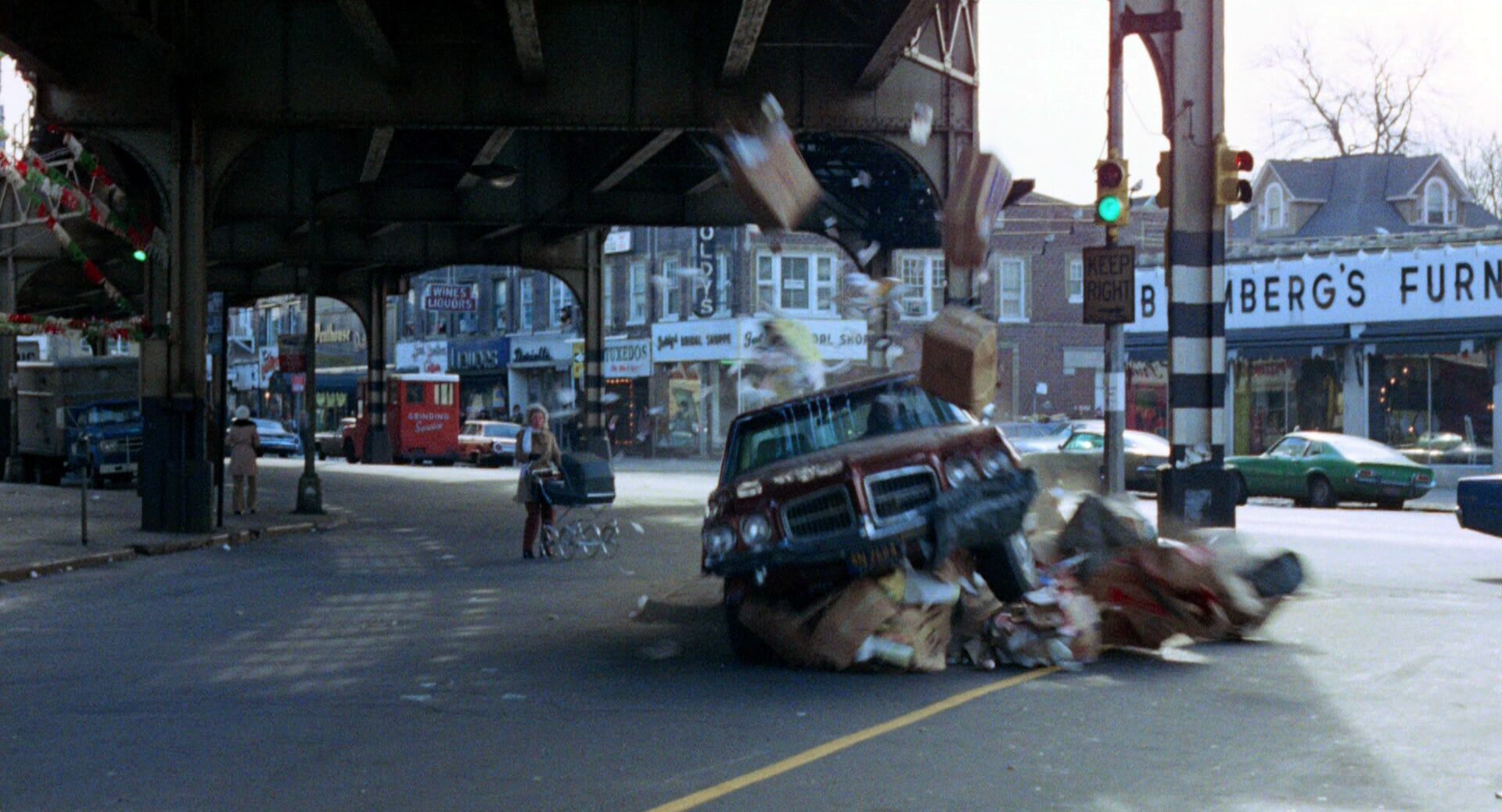
        This is the highlight of the movie. When you Google the movie this scene usually pops out. I’ll even go as far to say that this is the best car chase I have seen, and I’ve seen Baby Driver. This whole part links to my next talking point of the film. Everything about it just screams crazy. Especially since, Jimmy is chasing one of the associates involved in the drug trade. He straight up borrows a civilian’s car to follow the train. 
        Nowadays, you can’t film a chase scene without a permit. Especially since everything seems staged, because that’s exactly how it’s supposed to be. The point is that there was no permit for this chase. Every turn, civilian reaction, right down to the crash and bumps are real. I think that Gene Hackman is one hell of a stuntman, but an absolute mad man for driving like that. Obviously, words can’t describe just how well this stunt is. Even with pictures offering snippets of the chase. It’s that good, no, great. 
3. Friedkin Method 
        Will Friedkin’s way of shooting a film is one of the main highlights. He has a very distinct touch that I noticed when I watch The Exorcist. It looks like a documentary. What I mean is that mostly when a character is walking or there’s that moment in the only car chase we see just how far away the car and train are. Aside from that it has touches of guerilla filmmaking. The one thing that I do love since it was filmed in New York City is those shots of the camera just looking at the people walking in Time Square as both Jimmy and Buddy are driving. It reminds me of Taxi Driver and it’s not confirmed perhaps Martin Scorsese saw that moment and applied it to his De Niro film. 

4. Overall 
        I love this movie, it won seven Academy Awards including Best Picture. William Friedkin is the director that is overshadowed by the big name directors of his time, but he absolutely deserves to be in the same conversation after this film. 

        The French Connection gets a four out of five. 

Wednesday, May 12, 2021

Enter The Dragon Review


        This is the second martial arts film that I have seen. The first one was back in 2006 in New Mexico of all places when I watched Jet Li’s Fearless. Enter the Dragon is considered the cream of the crop of martial arts movies. The definitive in terms that it actually was Bruce Lee’s final film before his passing. Nevertheless, I felt it’s appropriate to talk about this movie and just how influential it was going forward. SPOILERS will appear. 

1. Martial Arts Action
        The main highlight is the fight scenes. There’s no dispute about that, we watch the film for the fights and it delivers on that. Well, to make sure that there’s more to it than the fighting, it’s about Lee played by Bruce who’s invited by a special agent named Braithwaite. Who tells him that he’s investigating a crime lord named Han. The agent needs Lee to go to Han’s tournament to gather evidence to help Braithwaite put him away. 
        I feel that the mixture of genre such as spy and martial arts works well in the film. Since it’s not just seeing action being performed by Bruce Lee and John Saxon. If it’s just the action, it would be boring. Having Lee do more than just fighting shows that the whole tournament has a bigger purpose than what anyone might assume if they just tuned in. Also, the stakes is personal for Lee. Since his father explains to him that his sister was killed by Han’s men and it means more for Lee to find and stop Han from hurting more. 
        The action is pure, simple and to the point. Nowadays, you can’t have a fight scene without multiple cuts of different angles of the skirmish. The beauty in this film’s combat is that Bruce Lee was involved with the fight choreography. Which explains why the fight doesn’t go on for too long. His combat style is something to behold, it’s an art in and of itself. Interestingly, Jackie Chan makes an appearance. It’s a brief moment, but I think it was the unintentional passing of the torch between two men who knows martial arts. 

        Aside from Lee, the other supporting actors do their best and are competent for being fighters. We also follow Roper and Williams, played by real life martial artist Jim Kelly. It would’ve been lazy to have them just to have them. As competition for Lee to fight in Han’s tournament. In actuality, both Roper and Williams know each other and there’s a connection right there. We understand why exactly most of the fighters are being invited by Han, so that they can be in on his drug business. I must stress, having a reason, a believable one makes the action more interesting. 
2. Brucesploitation
        Before his passing, Bruce Lee was supposed to star and direct the film Game of Death. He unfortunately passed away from a brain injury. Director Robert Clouse was assigned to finish Game of Death, and it was bad. Having seen snippets of it, he crafted a story using the existing footage that was shot by Bruce Lee. 

        Additionally, with the rise of exploitation movies in the seventies. Meaning that a movie that tries to be successful by exploiting current film trends and that results into films just being bottom of the barrel garbage. Martial arts films were popping up left and right, such as film’s that were exploiting Bruce Lee by putting an actor who isn’t the actor but daringly putting on the poster that the film has Bruce Lee. Sometimes spelling his name varyingly such as Bruce Li, Bruce Lai, and so forth.
        The trend ended when Jackie Chan made a name for himself in Honk Kong action films. Films like Drunken Master and Snake in the Eagle’s Shadow cemented Chan’s role as the new king of martial arts films. I will probably attest that more marital arts action stars such as Jet Li and Donnie Yen has expanded the genre to be an artform for the niche.  
 
3. Legacy
        Like most things, this film started a trend amongst various entertainment mediums. Marvel Comics decided to create a character who is like Bruce Lee called Shang Chi who’s an expert in martial arts. Might as well put it out there, he’s getting his own movie. Enter the Dragon has been referenced by various movies years after the fact. Like being referenced in one of The Pink Panther movies and some comedies. 
        I was not aware that it was an inspiration for manga creator Akira Toriyama to create the Dragon Ball series. Now thinking of it, Goku is like Bruce Lee who’s an absolute master of martial arts and fighting in general.  It was only a matter of time for video games to borrow some elements from the film. Arcade classics such as Street Fighter and Mortal Kombat places an emphasis on tournament and on silky smooth fighting. One last thing is that, since it has elements of espionage, it was the most successful spy film that wasn’t tied to James Bond. 

4. Overall 
        This film has done so much for various mediums. It’s the king of kung fu films that many movies that are released recently miss the point of what made this film so successful. Bruce Lee ultimately deserves to be a pop culture icon after the release. And it’s such a shame that it was his last film before his death. 

        Enter the Dragon gets a five out of five. 

Monday, May 10, 2021

Dirty Harry Review


        I will always maintain that the 1970s is the best decade for cinema. It was also a transition period between the classical Hollywood to the new one. This is the movie where law and order is subverted from any notion one would have with authority. Clint Eastwood became famous for his appearance in the “Dollar” Trilogy, this film made him an icon. SPOILERS will appear. 

1. “Dirty” Harry Callahan 
        You would think at a first glance at the title, such as Dirty Harry one would think that it would be a porno. Since in that time, it was surprisingly popular. Anyways, Harry Callahan is the inspector for the San Francisco PD. He has his own methods with stopping a crime. We actually see him stop bank robbers when he’s visiting a burger joint. That’s when we see one of the most famous lines that is often misquoted. 

        Beyond that, he’s attempting to stop a deadly sniper in the city, who goes by the name of “Scorpio”. He leaves ransom letters that threatens to kill more unless he is paid. Harry throughout the movie tries to stop him, by using his own way of vigilante justice to stop the killer. Harry is in no way an anti-hero, he’s a vigilante. Meaning that he uses law enforcement without legal authority. This is probably the first instance where we see a police member become rogue within his department. 

        Now, when confronted by his superiors and the mayor that his methods are borderline questionable, he justifies it by explaining that the killer has a hostage. It’s probably one of the most interesting factors in the movie, and it’s him being restrained with what he can and can’t do. An attempt was made when the department assigns an officer to work with Harry. This is one of the best moments because we get to see Harry working with someone. It explores how he operates with someone besides him. 


        Chico Gonzalez played by the late Reni Santoni, is the one who really tries to understand why Harry has the nickname “Dirty”. We learn that when Harry rescues a suicidal jumper, he tells him that he’s called “Dirty” due to the jobs he has to do. We learn more that Harry doesn’t really like anyone. Although, we see that change when chasing Scorpio, he shoots Chico and puts him out of the case. Harry visits him when he is in physical therapy. It’s those small moments that give him depth and subtlety to show that he has humanity.

2. Real World 
        During the 70s, the bay area was plagued by the Zodiac Killer. To this day, no one knows the identity. There is one part where Scorpio takes a school bus hostage and Harry stops him. During the actual time, the Zodiac Killer threatened to harm a school bus full of children. I think it’s one thing to make a movie where a town is terrorized by an unknown threat. Especially when the screenwriters create a character to stop an unknown killer. I feel and it’s not corroborated with evidence, but I think the movie was a warning to the Zodiac Killer. 


        We might as well talk about the methods that Dirty Harry uses. Aside from the fact that an actual murderer was running around in the San Francisco area, crime was up during that time around the country. People really felt that the character was supposed to be the answer for the rise of urban crime that was going on. Nowadays, the methods are mostly questionable. This film can’t be made today for obvious reasons. Although, just a few years later, the film Serpico was released and exposed corruption that was happening in the NYPD. 

3. Legacy
        It’s no surprise that this film was a success. It propelled Clint Eastwood to icon level status and sequels were made after the film. I haven’t personally seen the films, in my opinion it should not have any follow ups. The ending is perfect since we see just how much has transpired and Harry tosses his badge. Feeling that his actions has alienated him to a point where he can’t consider himself within the law. 


Aside from that the film has been universally beloved and has made it in the countdowns for best films and best heroes. Copycats would appear after the success of Dirty Harry, some good such as Death Wish and Shaft. The bad ones including the final two sequels to Dirty Harry pretty much miss the point entirely with what the first film was going for. 

4. Overall
        This is probably one of the best films that I have seen from the 70s. It’s getting to be a large list, but everything about it such as the characters, the way it’s shot and small moments where it looks like a visual time capsule. Dirty Harry is one of the best action movies I have seen and laid the groundwork for a compelling character.  

        Dirty Harry gets a four out of five. 

Friday, May 7, 2021

The Italian Job (1969) Review

        What is it with Italians popping up in recent films for this blog? Well anyways, now I’ll be talking about The Italian Job. A heist film from the 60s about a crew of criminals stealing gold in Turin, Italy. While it’s pretty simple of a film to follow, it has the one of the best car chases of the 20th Century. SPOILERS will appear. 

1. Charlie Croker 
        Michael Caine plays the lovable Charlie. We see him being let go of prison and being updated of a death of someone he knew. When the film starts, we see the Mafia kill a thief named Roger Beckerman. His now widowed wife updates Charlie on a heist plan to steal gold in Italy. Hence the title. 


        One thing that makes Michael Caine’s character charming is that he’s an expert planner. And with most heist movies, there has to be a moment where he hires his crew. It’s not just some small crew like you might find in the recent Fast and Furious movies. Croker hires a massive team of drivers, men to tamper with security, and decoys. The real appetizer to this movie is just the hype of seeing the heist being ready. 

        Another character trait that is probably forgotten is that he is a criminal. He’s only stealing the gold just for himself and the team. It’s interesting since the Mafia gets in the way of Croker and his crew since it’s implied that they want the gold as well. A little rivalry from the looks of it, but Charlie’s men manage to get the upper hand as the movie progresses. 

2. The Last 30 Minutes
        This isn’t a long movie by any measure. It’s approximately 1 hour and 40 minutes, most of it is just set up for Croker and his crew along with meticulous planning and restructuring the raid. The final half of the movie is the best part. Due in large part that we see everything going right in the heist. 


        Especially we see the iconic Mini Coopers in the film, all bearing the colors of the Union Jack flag of England. Now, I will admit that the car chase is rather tame in comparison to others since there isn’t a lot of cops chasing the drivers. Just for context, Croker explicitly tells his team that they need to cause a massive traffic in Turin in order for the heist to be successful. In turn, there’s little police present. 

        With that out of the way, the chase is fun to watch. Having to see the Mini Coopers drive down on a stairway and jump a rooftop is just classic. My part and just for the continuity of it is when they drive in the sewer tunnels. As they get out, they still have the filth and grime on the bottom of the cars. Some police cars do crash and it’s just fun to see them get swept or collide. 


        Nowadays, most of the car chases are just computer generated. It robs the audience of an authentic chase which can be full of thrills without any special effects or a computer to do. The Italian Job is one of those pioneering heist movies where the chase is the movie. 

3. Legacy
        When it was released in the US, it didn’t do so well financially. Although, across the Atlantic, it’s considered one of the best British films. It’s obvious since one half of the crew is dressed in England soccer regalia and the cars have the same colors as the Union Jack. The film was remade back in 2003, the reviews were good, but the one testament for remakes is that they’re not good as the original. Though, they do have updated Mini Coopers so they do have that going for them. In India, the movie was made into a Bollywood movie in 2012 called Players


        The movie was actually adapted into a video game for Sony’s Playstation and Windows, 40 years after the fact. I haven’t played the game, only made aware of it due to Cartoon Network’s programming block Toonami doing a game review of it. One thing that is endearing is that the film inspired a charity. Called, well what else The Italian Job which the proceeds go to children’s charities. The “Job” involves the a line of Minis cars go through a trek from the UK to Northern Italy and back.  

4. Overall 
        This is a relic of the time and it shows. It still holds up as a great heist film and a great Michael Caine movie. His suave and genius is shown, and the final part of the movie is worth it from the buildup.

        The Italian Job gets a four out of five. 

Wednesday, May 5, 2021

A Fistful of Dollars Review


        To kick off my venture to action movies from the 60s to the present, I’ve decided to look at the movie that made Clint Eastwood into a household name. Technically, he had appeared uncredited in B-Movie films like Revenge of the Creature and Tarantula!, among his other appearances in various movies and tv shows. A Fistful of Dollars propelled him into a western icon. The film is actually made by Italians which I’ll explain later in the review. 

1. The Man with No Name
        Throughout most of the movie, we follow Eastwood’s character. He doesn’t have a name but is referred to as “Joe”. As the film series progress, he has more names associated with himself. Anyways, he approaches a small Mexican town of San Miguel, which looks deserted. When he strolls forward, “Joe” realizes that the small town is under control from a group of bandits called the Rojos. They are in a heated conflict with the Baxter clan. 


        He notices that the civilians that he sees are living in squalor while the two clans keep their side of the town. Inevitably, he decides to play both sides of the different families. We learn that he isn’t really a bad guy or a good guy. He mostly expects to be paid when he does work for them. This is what you call an anti-hero, it’s a type of character who lacks any standard heroic attributes. It makes sense when he’s just a wanderer. 


        We do ultimately see him perform one heroic act. As he was riding into town, he sees a woman behind a chained window of a house. As the film progresses, he learns that the Rojos have kept that women, Marisol from her husband. He sneaks into the Rojos’ compound and break her out. The Man then gives the couple his earnings from the jobs he did with the two families. It’s the little moments that give him a moral boundary. As well as him saying that he met another woman like her in his past. 

        He even makes a few acquaintances with the town folk. Like the owner of the cantina Silvantino, who gets him updated with the town's situation.  I love his growth in the film, since he starts off as just looking out for himself. My favorite part is when he takes "Joe" to see a gun deal being established between the Rojos and the Mexicans. Which devolved to a massacre and setting up the Man's plan to pit the Rojos and Baxters against each other. 


2. Spaghetti Western
        So let’s talk about this sub-genre. I’ve been hearing every now and then and it vexes me to no end, since why exactly does spaghetti have to do with anything. The name was coined by Spanish journalist Alfonso Sanchez. Well, from what I gathered, the western genre was beginning to see a slow down in the US. Meanwhile, director Sergio Leone saw the potential for westerns in the Italian market. 


        The locations of the film for instance looked dry like the planet Tatooine. They were filming in various locations around Italy and Spain. This actually wasn’t the first time where Europeans had a hand with developing the Western genre. Back in the late 19th to the early 20th Century, the Lumiere Brothers made westerns in Europe until they decided to do more in Texas in San Antonio. 

        With the release of A Fistful of Dollars, more films from the sub-genre laid the foundation of how different Spaghetti Westerns were in contrast with the Westerns made in America. Films like Django were ostensibly foreign since they had little to no American casts. One thing that I noticed during my viewing of this film was that most of the voices that wasn’t Eastwood’s were dubbed. Since the film was both a Spanish and Italian venture. 

3. Legacy
        Like most films it established a precedent of the genre and added some fuel to it to keep the genre going. Clint Eastwood has a productive career after the release of the film, and as I mentioned earlier has joined a few actors who made western popular. It wasn’t until the early 90s where he would eventually direct, produce, and star in the film Unforgiven, which won best picture in the academy awards. 


        Eastwood’s character has been referenced in other film genres. In the Star Wars franchise, characters Boba Fett and The Mandalorian's Din Djarin have taken some ques from the mysterious protagonist. Eventually having appeared in films and television series in Disney’s streaming service. More so on the whole look of the film may have inspired George Lucas to reference the location of San Miguel to become Tatooine’s city Mos Eisley. 

        The music by Ennio Morricone has been synonymous with the western genre. It’s often imitated and copied in various media. Including the recent video games such as Red Dead Redemption and its sequel. Just this past decade, Quentin Tarantino paid tribute to the Spaghetti Western with his film Django Unchained. Which was actually based on the Django series that was part of the sub-genre during its popularity. 

4. Overall
        For Clint Eastwood’s first action film or western, he does a good job. Sergio Leone has done a great job with putting some stimulus with a genre that appeared to be losing steam. Clint Eastwood’s character is really interesting and laid the groundwork for the future anti-heroes to appear later. 

        Fistful of Dollars gets a four out of five. 

Monday, May 3, 2021

Jaws Review


        Summer’s officially here, not really but since its’s now May I will be dropping new reviews three times a week. One can’t talk about summer blockbusters without having a civil conversation about Steven Spielberg’s Jaws. It’s unfathomable just how this one movie about a really big fish changed the landscape for cinema. At the time, no studio released a hyped movie during the summer. After the release of this film, every studio releases their slate of films that would hopefully turn a big profit. So let’s get started. SPOILERS will appear. 

1. A Monster Movie
        Little do people know that this film is based on the novel by Peter Benchley. He actually co-wrote the movie along with screenwriter Carl Gottlieb, it’s one of those rare instances where the author has a hand with the film adaptation. At its core, the film is about a Great White Shark running amok in the peaceful Amity Beach. With Chief Brody played by Roy Scheider who takes it upon himself to protect the civilians from potential attacks. Not only does he have to deal with the animal, but the mayor of the town as well. 

        When being presented with the details of how serious the shark attacks are, Mayor Larry ignores them and goes ahead with opening up the beach to the tourists to relax and have fun. He explains that the town is reliant on the tourists for income, which I’ll give the film that since it’s too easy to make a politico in the film just unlikeable. He has a reason. And like most things, it bites him in the ass. 

        One would consider this movie to be either: a monster movie, anti-capitalist movie, adventure movie, or obviously a summer movie. It manages to be all of them with no overlap or inconsistency in terms of drama and urgency. Since, the actual animal in question is only in the movie for a little bit. To make up for it is the great character interactions that give everyone depth. Those are the best part since if it had the shark every couple or so minutes, it would just be a plain B-Movie. 


        To put it into context, some movies involving animals going on a rampage are pretty bad. Especially the ones that involve giant spiders or other bugs that were popping up back in the 50s to capitalize during the Atomic age when the bomb was still in everyone’s mind. Here it’s played straight, a Shark seeing humans and eating them as they encroach in its territory. It’s not a bumbling monster or one altered by science, just an animal living and eating. 

        One last thing is that iconic music. It's so simple, even referenced here and there in movies or any situation. The music remind me of heart beats when the animal is approaching. What I like is that we are trained that when we hear the music, the shark appears. The film goes above and beyond to have the shark pop out without the music. It made me terrified since I was not expecting the moment for the shark to breach the surface. 


2. Chief Brody and Co. 
        To put it out there, during the filming of Jaws the animatronic wouldn’t work all the time. Spielberg made up for it by having most of the film be character driven. That’s where we see Brody meeting Hooper played by Richard Dreyfuss and Quint played by Robert Shaw. We progressively get introduced to them when the small town react to the shark. With Hooper being brought in to analyze a remnants of the first victim we see. 


        Quint is probably the most interesting out of all them. He has one moment where hunting the shark is personal but we’ll get to that momentarily. What’s great is that we each understand what’s in it for them to see and kill the shark. It’s obvious for the Chief that he’s the one who oversees the town to make sure everyone is safe. Hooper is from the Oceanographic Institute and likes to study Sharks. He joins Brody to hunt down and stop the Great White. 

3. USS Indianapolis Monologue 
        And then we have Quint, he’s the no-nosense guy who’s old fashioned with finding the Shark. When being presented with Hooper’s equipment, he laughs it off and uses his own knowledge to track down the aquatic animal. He has an old fishing boat called the Orca, a far cry from the technologically advanced ship that Hooper uses when Brody invites him to find the Shark. At first he starts off as the weird guy in town. 


        We warm up to him when the trio head out to the waters to finally hunt. He chastises Hooper for not knowing how to tie a specific knot. Other than that, he is the one to have most experience when he and Hooper compare scars on their bodies. That’s when we hear the story that should’ve gotten Robert Shaw a nomination for best supporting actor. He explains that he was part of the USS Indianapolis sinking. Which was the ship that sank during World War 2, and the survivors were eaten by swarming sharks. 

        Just him explaining the story and both Brody and Hooper listening show just how much hunting the shark means to Quint. The fact that all of them have some reason as to hunt for it, but it comes with the personal vendetta. There was a plan to have that story be a prequel to Jaws and have it follow Quint’s exploits. I’m glad that it didn’t go forward, since it would’ve ruined just how mysterious the character is. 

4. Legacy
        The influence that this movie had was felt during and after the release. It was released in 900 theaters across the country and ran throughout the entire summer. More so that it was merchandised to hype up the film. Before Star Wars, it was the highest grossing movie at that time and have a massive impact on pop culture. When it was inevitably broadcasted on television, people watched it by the millions. The film propelled Spielberg to a prominent director and to be one of the greatest in all of cinema. 


        Unfortunately, there had to be sequels. I haven’t seen them, I have no chance to ever watch them since just by name association they are inferior. The third one even had the ambitious idea of making it 3-D. That's not even the worst part, the fourth one involves the damn shark stalking the Brody family for revenge. Since that’s what the fourth movie is called Jaws: The Revenge. Just the idiocy of the sequels inspired more directors to direct shark movies that are nowhere near as good as Jaws. I will let you in on a secret that there's 50 crappy shark movies involving weird situations like a tornado to odd animal fusions. It's something where you need to drink heavily to get over just how bad they are. 

5. Overall 
        To put it bluntly, it’s nearly 50 years old. It still holds up as one wild ride and influential film of all time. Need I say more? 

        Jaws gets a five out of five. 

Wednesday, April 28, 2021

The Player Review


        Throughout the entire month, we’ve looked at various filmmakers behind the camera. From just some clerks from the local video store, to an ambitious one discovering a giant ape. Then there’s Tommy Wiseau, you get the idea that these directors are varying in their talent. Although, there’s hardly ever a film that show’s what happens in the studio lot. If its any case in Robert Altman’s The Player, a whole lot of bureaucracy and paranoia occurs with one producer. SPOILERS will appear. 

1. Griffin Mills 
        Played by Tim Robbins, Griffin is our eyes and ears with what happens in a Hollywood studio. He’s a studio executive that hears story pitches, he only picks 12 out of 50,000 in a year. One day, he gets a series of letters that have vague threats written on them. He manages to find one of the writers who was offended by Mill’s denial. The disgruntled writer David KaHane played by Vincent D’Onofrio, gets mad at him for rejecting his script. 

        Becoming frustrated by KaHane’s arguments towards him and joking that he’ll lose his position in his job, Mills drowns the writer in a puddle of water. You would think that the letters would stop and Griffin has to now worry about a rival exec who wants to take over his position. It gets worse for Mills, as more letters pop up and faxed in. Soon, we see the sleazy exec becoming paranoid and attempting to steer clear from any reasonable doubt that he killed David. 

        Griffin is an interesting character, obviously different from the ambitious directors and Tommy Wiseau. There’s something about him where his sleaziness is his character, but he knows what works for a movie to succeed. He’s just part of the system that won’t take something that’s risky but knows how to make it pleasing for the other execs who want it to succeed for them. To put it bluntly, he’s full of shit. He talks about how they need to make movies be the art that it is, by citing famous director Orson Welles. Then in another moment, completely butcher an ambitious movie to keep it safe for the audience. 

2. Satirizing Hollywood
        The first minute is a one take shot and represents how the inside of Hollywood works. With overlapping dialogue and the camera moving from one meeting to another, this is the view that not many people see. There’s some real Hollywood cameos that’s littered in that opening shot and in the rest of the film to keep it real, well for Hollywood standards. There is one part that perfectly sums up Hollywood at its worst but makes sense when anyone is in such power like Griffin. 

        He goes to one of the restaurants expecting to meet the mysterious writer but is hounded by two writers who pitch him an interesting story. His script is called Habeas Corpus, the irony is deafening. One of the writers Tom is insistent that they don’t alter the ending, which he describes as depressing and real life. Much later in the film, everyone in the studio see the new cut of the film with a happier ending than the one that was originally pitched. Tom explains to Griffin’s girlfriend that the audience hated it. And they changed it, which is real life. Much of that shows just how everyone can be a hypocrite in Hollywood. Since he now embraces selling out just to have his movie become possible. 

        Other than that, most of the film can be interpreted that Robert Altman has seen some stuff while he was a director when he was alive. Looking him up on Wikipedia, most of his work is mostly Anti-Hollywood, and this film fits that idea like a glove. Perhaps, he saw just how awful the institution was and maybe wanted to make a satirizing take that’s slightly less agonizing to work with. 

3. Overall 
        This is a great film that is mostly an acquired taste. I feel that it’s a perfect bookend to this month to wrap it up where most of the decisions come from. One who follows the ins and outs of Hollywood as a satirizing comedy, for the regular Joe, it’s a view that is a weird perspective into one side of Hollywood no one wants to sell their soul to work in. 

The Player gets a four out of five. 


Saturday, April 24, 2021

State From The Top #10

            Howdy everyone, the next three months will be dedicated to the summer blockbuster. This will be a big ambitious thing for me since I will be reviewing three films in a week, instead of the standard two. That and I’m drawing close to my 100th review. Might as well let you guys in on it. The 100th film will be Zack Snyder’s Justice League. I feel it’s poetic since for my 50th it was the studio cut of Justice League.

            So this is how it will work for May, June, and July. Starting in May, it will be dedicated to the action films from the sixties to now. Obviously, one can’t start a conversation without doing a review of Steven Spielberg’s Jaws. Which ushered in the summer blockbuster. Then in June will be a dedication of the best animated movies the country has put out. Including some that were beloved elsewhere in other countries.

            Wrapping the whole summer slate of reviews will be the reviews of the Superhero movies. It will be an amalgamation of Marvel and DC films. As well as others from other publications and original ones made for the movie. I know that I did a massive slate of the inconsistent DCEU films back in January. But this is the Summer Movie Slate, we will be talking about the great films* that people may or may not have seen. So here it is, the slate of movies for the Summer season.


May

Jaws 5/3/2021

A Fistful of Dollars 5/5/2021

The Italian Job 5/7/2021

Dirty Harry 5/10/2021

Enter The Dragon 5/12/2021

The French Connection 5/14/2021

Robocop 5/17/2021

First Blood 5/19/2021

Raiders of the Lost Ark 5/21/2021

Speed 5/24/2021

The Bourne Identity 5/26/2021

John Wick 5/28/2021


June

Snow White 6/2/2021

Fantasia 6/4/2021

Cinderella 6/7/2021

Fantastic Planet 6/9/2021

Persepolis 6/11/2021

The Breadwinner 6/14/2021

Toy Story 6/16/2021

Monsters Inc. 6/18/2021

Finding Nemo 6/21/2021

Underrated Gems: The Iron Giant 6/23/2021

The Prince of Egypt 6/25/2021

100th Review Zack Snyder’s Justice League 6/28/2021

How to Train Your Dragon 6/30/2021


July

Superman: The Movie 7/5/2021

Flash Gordon 7/7/2021

Batman (1989) 7/9/2021

Darkman 7/12/2021

Underrated Gems: The Rocketeer 7/14/2021

Men in Black 7/16/2021

Blade 7/19/2021

X-Men 7/21/2021

Unbreakable 7/23/2021

Hellboy 7/26/2021

Kick-Ass 7/28/2021

Dredd 7/30/2021

Mission: Impossible - The Final Reckoning Review

          I just want to straight up apologize for the extremely inconsistent schedule for this franchise. I usually plan ahead, but persona...