Wednesday, October 5, 2022

Frankenstein (1931) Review


        Back in the 1930s, Universal contributed to the growth and popularity of the horror genre. With the success of Dracula, producer Carl Laemmle Jr. decided to do another adaptation. This time by focusing on the novel by Mary Shelley. Considered by many to be the best out of all the Universal Monsters, Frankenstein made an immediate impact in pop culture.

1. The Monster
        The way the movie starts is interesting. It has actor Edward Van Sloan give caution to the audience before the movie starting. I want to say that it’s the first time that an actor or someone from a production would introduce the film. As far as I know that this method has been used again for The Ten Commandments when Cecil B. DeMille introduced the film before it started. So yeah, for the time I think it works since no one could’ve imagined what they’ll be seeing. 
        For the most part, the film is loosely based on the actual novel itself. In fact, the movie is based on the theater play. Much like its counterpart Dracula. It does contain various plot points of the book, but it mostly diverges and instead focuses on the scientist himself. Henry decides to reanimate a dead corpse with his assistant Fritz. This is the thing that people easily think that the crazy assistant is called Igor. I’ll talk about that aspect later. 
        Anyways, as the doctor creates his abomination, his former professor tells him that the brain he used was that of a criminal. And you can probably imagine what happens from there. What I like is that we get a lot of focus on Henry. We understand what drives him to create. It’s his pride and overall sense of curiosity of doing something that hasn’t been attempted. Specifically, we learn from him that he wants to ‘renew’ life and discover the mysteries of life and death. It would’ve been easy to just make him a wacky scientist with no real cause or want. 
        I think the overall theme of the movie is the idea of the monster. When we see Frankenstein, he’s just a lumbering being who doesn’t know from right or wrong. You can probably say that he’s literally a newborn with stitched up parts. The film exposes who really is the actual monster. We see Henry’s assistant whip the creature into submission, as the monster grunts and yells. It’s not so much that the monster is a brute, but ultimately the one who wants to control it. 
        Of course, I can’t continue to talk about the film without talking about the creature itself. This film put Boris Karloff on the map. In fact, it was a rumor that Bela Lugosi was going to play the character but backed out considering that the creature didn’t have lines. Although, it was the filmmakers that wanted Karloff and not Lugosi. The way the character looks has been the defining look for generations. You don’t have to watch the movie to know that the monster has a flat head with bolts sticking out his neck.

2. My Favorite Scene
        This one scene in particular has been for awhile cut, depending on if you lived in some states in the US. The scene in question is the one involving Frankenstein and the little girl Maria. As Frankenstein escapes from his confinement, he wanders and happens across the young girl. She’s showing him how to make a flower float. The creature unintentionally murders the girl as a way to mimic what he learned. 
        The scene is the best moment in the film since it adds depth to the creature. For one thing, it showed a little bit of humanity when the creature was playing with the little girl. It almost gives us just a glimpse that maybe the monster can learn to be good, considering that his brain is that of a criminal. Unfortunately, that’s not the case at all. In one way, it’s actions leads to the destruction of Henry’s lab and his seemingly destruction.

3. Legacy
        This one movie helped expand Universal’s Monster Universe. It made bank in the box office, which prompted the producer to make more films out of other established works and mythology. The creature has spawned a series within the overarching franchise with four sequels and a comedy. Also, it created a cliché with the mad assistant. The sequels had a character named Igor, but he was just a blacksmith. In fact, the hunchback assistant did pop up in the sequels, but was called Daniel. 
        Also, it’s one of the first characters to do a crossover. Before Marvel Studios or whatever Warner Bros. has been attempting to do, Universal had their stars duke it out before. It was dubbed a ‘monster rallies’ since it involved some of the monsters to fight. Aside from that, this character has been adapted in other movies and his look has popped up in various Halloween decorations. 

4. Overall
        Frankenstein did what so few movies try, be a hit and have a lasting impact nearly a century later


Saturday, October 1, 2022

Nosferatu (1922) Review

.

        Happy October! It feels good to finally arrive at this month where I get to talk about horror. Well, think of it like a personal view guide from the early part of the 20th century to now. As always, the toughest part of picking which movie to talk about is always the ones that get left over for next year. That’s always a pain, but you still get an appreciation of how one genre evolves and spawned a sect of sub-genres. With all that out of the way, let’s talk about the most influential horror movie. 

1. Story without Dracula
        There’s so much behind the scenes info for this movie. For one thing, it was supposed to be an adaptation of Bram Stocker’s “Dracula”. Although, the filmmakers didn’t have the license to make the adaptation. To get around it, they altered how the story is being presented. Mostly retaining the central idea of “Dracula” but creating a new character. 
        Basically, the story involves Hutter who is tasked with helping the hermit Orlock get a piece of property. As he travels to meet with the recluse, he scoffs at the inn’s residents about the danger of the man. So much so he reads a piece of text that describes the count but laughs at the absurdity of it.
        Even though the movie is 100 years old, it’s always interesting how it’s presented. I’ll elaborate more on the version of the movie that I watched. The main gist is that during the silent era, the European way of showing horror was showing the macabre and grotesque. While the American way of horror was more psychological and understanding the monster or threat. 
        More so when watching a silent movie, there’s no sound. It’s interesting how the story is presented with the body language of the main character. We can imply what’s being talked about when we have brief moments of dialogue of what’s being said. Additionally, see what’s being established as the next act or scene is about to take place. 

2. Count Orlock
        Yeah, Nosferatu is the stand in for Dracula. The way he’s presented still elicits that creepy aspect about him. It’s his face, something about it without ever uttering a sound has that unsettling factor to it. Even when he moves, its stilted but its just uncomfortable to look at since with it being in black and white enhances his threat. 
        When watching the movie, you’re probably wondering why there isn’t a bat. One motif that I found interesting is that he’s mostly associated with rats and vermin. Once more with his face, there’s a shot where he has sharpened buck teeth. Fitting since he bites his victims, and it leaves the distinct mark. Additionally, the motif of rats is appropriate since that’s usually associated with disease. 
        For instance, when he boards the ship to head for the main characters town. One of the sailors checks on the coffin cargo. He damages it and sees that it’s full of rats as they spill out. Ultimately, we see the Count rise up strangely. In fact, when translating Nosferatu from either Roman or Greek languages, it says either unclean spirit or bringer of plague. Again, as the creature is mostly associated with rats. 
One more thing that makes this character distinct is his shadow. You don’t have to see the movie but that iconic shot of his shadow going up the stairs is the main highlight. I feel that his shadow is supposed to be a representation of the art style called German Expressionism. If you want to know what that is, please refer to my review for The Cabinet of Dr. Caligari. Anyways, it’s more tame than Caligari, but manages to show fear when we don’t see the actual figure.

3. Legacy
        As I mentioned before, the filmmakers weren’t allowed to use Dracula, but they forged ahead. They even included the credit of being inspired by the story. Inevitably, the widow of the author took the filmmakers to court, and the judge ordered the film to be destroyed. For a while it was a lost movie. Various copies popped up in different parts of the globe, but were damaged due to the film being combustible. So, what I saw was a surviving print.
        The movie has been an immense influential piece of cinema. Many more films adopted the gothic feel of Nosferatu and copied characteristics that have since become a defining feature of a vampire. As always with any movie prompted a remake with filmmaker Werner Herzog‘s adaptation in the 70s. And it was adapted once more in 2000 under the name Shadow of the Vampire. That one was framed as a ‘making of’ featuring John Malkovich and Willem Dafoe. 
        In fact, my first exposure to Nosferatu was Spongebob Squarepants of all things. It was in the episode "Graveyard Shift". Near the end, the main characters figured out what was causing the lights to flicker and lo and behold it was the Count. Surprisingly, it’s being adapted for a second time. With director Robert Eggers helming the adaptation. I trust him to deliver on the goods since he has a knack to make his films feel historic such as The Witch and The Northman.   

4. Overall
        With Nosferatu being 100 years old, I recommend watching this influential piece of cinema to see how far the vampire has evolved. 


Wednesday, September 28, 2022

First Man Review


        It only seemed appropriate to talk about the movie that showcases perhaps NASA’s best astronaut. No one could’ve imagined that we would have the technology of putting a man on the moon. This whole month was dedicated to the people that made NASA to an iconic organization, while timewise the whole presentation of the films are in fluxed. With my reminiscing out of the way, here’s First Man.

1. Neil 
        Of course, for the someteenth time, this film is based on the biography of the same name, detailing the life of Neil Armstrong. This is probably the most different in terms of NASA movies that I’ve seen throughout the whole month. You have the ones that focus on a group and a failed mission. Here though, we see an intimate portrayal of the guy. 
        Ryan Gosling does a great job of portraying the astronaut. And man you have to feel for the guy as he is just full of sadness. I’ll get to that in a moment. Throughout the movie, we see him in his tenure with the organization by becoming part of the Gemini Program and inevitably the Apollo moon missions. In between that, we see just how much he struggles with loss in his personal life and in his work. 
        As I mentioned earlier, this is an intimate view of an astronaut. I feel that this is focused more on the humanity than the actual accomplishment of going to space. From the start, we see him as a pilot willing to do the impossible. Then transition to the loss of his daughter. The only thing he has of her is a bracelet she made. 
        The big idea of the movie is this idea of loss. As we see Armstrong, we start to see just how much in terms of emotional baggage he gets. He loses his friends and coworkers within NASA to prepare for the next step of space travel. Like, he doesn’t cry but he keeps going as we see just how much he’s willing to get to the moon. 
        I feel that when people watch this, they’re going to wonder why exactly we don’t have that moment of planting the flag on the surface. The last president complained about it and maybe anyone who watches it will get disappointed. Watching it is not about that level of patriotism . Even a celebration but how much something this large a magnitude requires the sacrifice to keep going. 

2. From Music to the Stars
        This is the second movie that I’ve seen from director Damien Chazelle. You may know him for directing La La Land and Whiplash. Talk about a big shift from music and going to the moon. While I haven’t watched his recent film, the recurring motif I’ve noticed when watching First Man reminded me a lot of Whiplash in some respect. 
        You have a guy that is motivated to get to a specific place in his life. To get there, you see the main character slowly become more isolated from when he saw him at the beginning. In one way, you see Neil dedicate his work as a way to grieve. Becoming increasingly isolated from his family. So much so that his wife makes him tell his sons about the obviously dangerous mission he’s getting into. 
        One more thing I want to mention is that there were loads of moments where the action was extremely intense. I’m talking about the scene where there was an emergency when he was part of the Gemini 8 mission. I was shocked by how intense it was, exacerbating it was my sound bar which really made it more extreme. I think it’s a personal touch of Chazelle to put the audience in the situation. Like in that one moment in Whiplash with the car accident. 
        It's probably an obvious, no-brainer spoilers that Armstrong goes to the moon. That scene works in two ways. One, when he first steps off the landing module, the aspect ratio, the black rectangles, go away and the whole image completely covers the screen. It’s quiet and we see Neil just taking it in and looking back on the Earth. Two, the silence I think subverts number one by stating to us that is this all worth it. Just an empty lifeless rock where the only thing we can hear is just the breath of Armstrong.

3. Overall
        I love this film by showing us a different point of view for this astronaut. First Man is probably the only space flight movie focus on man’s sacrifice and loss in trying to get to the moon. 


Wednesday, September 21, 2022

Hidden Figures Review


        I feel like with this movie was a necessary one for the overall history of NASA. I never had a chance to watch the film when it came out a few years back, but it made the rounds of best film of the year to being in a countdown of best space flight movie. Hidden Figures doesn’t change history in the least bit, but it adds on to show that there were other people involved. No one thought that these ladies contributed with the difficult task of figuring out how to get a man to space. 

1. Added History
        To think that mostly all of NASA’s internal mechanisms involved another gender. In one way, I can understand when someone is looking at the history of the organization. You wouldn’t find a book that talked about the behind the scenes. Not to besmirch the art of number crunching or dealing with a very toxic era such as in the early 60s. But I think that we focus more on the actual astronauts and less on the people who do the actual talent of figuring it out. 
        With that, I’m a sucker for historical movie so I was tuned in from the start. The three ladies that we see do a great job of portraying Katherine, Dorothy and Mary. I’m glad that we see some scene to explain that they do know how exactly to do math and use the new machine called a computer. I’ve never heard of it. 
        Among the trio, I feel like the main central story is mostly on Katherine. We see from the start that she’s a prodigy in mathematics. Not to say that the others aren’t that important in the context of the movie, but I think that the movie dedicates her when the actual space flight is concerned. Even though math isn’t my strongest suit, I do like just seeing how it all plays out. 
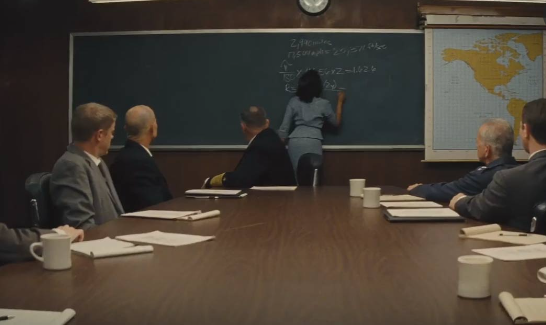
        One bit I do like is when Katherine is involved with the project lead’s meeting with the other generals. She calculates the landing position when John Glenn descends from his orbit. There’s one moment where she’s writing the answer and she makes a mistake, but she instantly fixes it like nothing. 
        The main reason why I like this film is that it mostly sticks to the formula of them managing to become part of the group instead of separate. It’s apparent that in the moments that we see them individually, the entire workspace is different. Like duh, it was during the time where they were separated from their white colleagues. But more so that the workplace is mostly male dominated. For instance, when looking at the landing capsule, Mary gets her heel stuck from the floor vent and must run to escape the test velocity. 

2. Period Piece
        As I touched upon earlier, this was during the time of the later years of Jim Crow. I was astonished to know that a government facility followed the separate workplace and bathroom for all the employees. For one thing, it really puts it into perspective on the whole need for these women. The US was falling behind the Soviets and the tools that we had were being restrained. 
        To anyone who watches the movie and think that Jim Parsons or Kirsten Dunst are the worst in terms of characters. I’m glad that they’re not just the typical racist, just inconvenienced with how things operate. Me personally, they represent just the times. And when you have Kevin Conroy’s character be the no-nonsense one to really understand what’s going on. 
        Watching this movie, it reminded me of various parts of The Right Stuff. They even included the moments of the rockets failing during testing and when the capsule sank into the depths. I wonder now if the women’s contributions were kept under wraps or were simply not documented in a way where you had to know someone who was there and knew the women who did the work. 

3. Overall
        Hidden Figures is a hidden gem when it came out in 2016. I’m glad that it exposed a different historical point of view that no one knew happened. 


Wednesday, September 14, 2022

Apollo 13 Review

        It’s rare for a moment to happen and think that it only happens in a movie. Apollo 13 proves that idea wrong. An event where NASA hadn’t prepared for and didn’t think could happen in a worse place imaginable. The movie is considered one of the best, by how accurate it was in terms of NASA lingo and the many ways the men at Mission Control tried to bring the crew of the failed flight back home. 

1. Successful Failure
        The phrase is a perfect example of what an oxymoron is. To put it simply, I think it fits with the whole mission when its presented in the movie. Seeing just how much the trio of astronauts train and the last-minute change in the line-up. Tom Hanks does a great job of playing the lead as Jim Lovell. No actor had a great decade in terms of acting than Hanks. He was everywhere, and he has that aspect about him where he can be the guy. 
        It wouldn’t be a film about space travel without Ed Harris. I think that his performance was so good in The Right Stuff, that director Ron Howard gave him the role because he’s the on earth counterpart with everyone reporting to him. Before I talk about what goes on in the failed flight, I just love what happens in Mission Control. It's the constant communication where everyone is on top of what they're supposed to be looking at.  
        As soon as the event happens, everybody scrambles but not panicking. Harris’ character calls a meeting to figure out how to bring the crew back. I just love this scene since for one thing, everyone’s smart. They spitball ideas but I just love Harris’ tone and challenge for them to conjure a plan. The best scene is when a small crew of guys create a makeshift device out of just leftover equipment they had lying around. 
        Those moments represent the overall themes of the movie. Adapting and persevering or managing to control what they can control. This is something where it can be easily relatable to anyone who has that moment where they can only control what they can during chaos. When we see the Lunar Module blow up, the astronauts all remain calm. Managing to be reasonable and levelheaded. Anyone will lose their minds if something unexpectedly happens. 

        It just sets up the overall tension for the astronauts’ families watching to see what’s going on. I appreciate that the film is committed to the time era via the news broadcast and we get to see bits of the NASA guys sleeping and working around the clock. Prior to that, there’s a certain dread where everything gets changed or something unexpectedly happens. To me, it sets up what’ll happen, but I’ll admit its on the nose when Lovell’s Corvett is acting up on a drive. 
        One last thing, this is one of those rare underdog movies where everyone shines in the darkest moment. We don’t a single scene where a fix comes in and the problem goes away. There are bits in the film where there’s another problem that impedes the astronauts from building a makeshift device. That’s where one of the themes comes in. 

2. Lost Astronauts 
        The thing that makes the trio of astronauts work as characters is that they are human. Like duh right? We see them as heroes in the film, but what I like is that we see more personality and that gets the best of them. Aside from Lovell and Bill Paxton’s Fred being chummy, they have a subtle discontent with Kevin Bacon’s Jack Swigert. 

        Through Swigert pressing the button, it unintentionally ruptures a tank inside the space craft. While we see the three of them working together and hearing Mission Control’s plans, I love the moments where they get frustrated. It shows that in an obvious situation they are vulnerable. Just the shots of the trio together show that Jim and Fred are close, while we see Jack slightly out of the duo. 
        Now, when watching the movie, you’ve wondered how they managed to pull off the convincing zero gravity. Obviously, they didn’t go to space since it would be a tough sell to the government. In fact, NASA has a specific plane that gives Astronauts a tiny glimpse into weightlessness. Dubbed the Vomit Comet, the plane was used for the interior of the lunar module. From what I read, they had about 20 seconds to experience zero Gs. Which meant that you could probably tell that the footage they used was cobbled together as a way to show its one scene. 


3. Overall 
        Apollo 13 is considered the best in terms of Space Flight movies. Everything is perfect enough where it can be pulled off as an in-depth documentary. 


Wednesday, September 7, 2022

The Right Stuff Review

        It was only a matter of time before I talked about movies involving space flight. Now, the general opinion on NASA is that they’re mostly liked in the public perception. Like, you can’t go a day anywhere without seeing a person wear a NASA shirt with the iconic blue symbol. Something about the organization imbues a sense of wonder that we can put a human to space and on a celestial body. I don’t mean to wax poetic a government organization, but the untold stories of the pilots, astronauts, and the people behind the scenes are rife with stories to tell. With that, here's what I think of The Right Stuff. 

1. Trial and Error
        You probably aren’t aware of the missions NASA was doing before the Apollo moon missions. Well, to put it simply, the Mercury program was the country’s first attempt to put a man in space. We get to see that on display in the three-hour epic. To me, it never felt that it was dragging or slow in general. I’ll get into the specifics on why the film’s a classic. 
        Specifically, we start off by focusing on the fastest man to go Mach speed. Chuck Yeager is mostly relegated to supporting character but seeing him take of in an experimental aircraft just whizzing must’ve taken a lot of balls. We see a reason as to why Chuck takes up on that offer, since it’s established that a group of men wanted to break the sound barrier. 
        The only problem is that the preceding pilots have died. Compounding on the issue is that Chuck gets hurt before the launch but manages to power on through. Now that’s one act of setting up the overall theme of the movie. The other is seeing the astronauts as the movie progresses. I was surprised that some of the actors that I saw were unknowns at the time. Like seeing Dennis Quaid and Ed Harris bring a charisma to playing their astronaut roles. 
        Aside from that what the movie does so well and it ties with the overall theme of the movie is showcasing the perseverance. What I like is that most of the astronauts that we see don’t like each other. When we see them together, they’re mostly in little cliques or gossiping. It gives them depth and slowly unveils the caricatures that they’re just pilots/astronauts. 
        More so that we see just how much medical tests they are involved in. One in particular becomes a game for them to see who can last the longest. And of course, it has the humor of being in an unfortunate procedure where they’re rushing to go to the bathroom. The movie doesn’t shy away the methods and the trials/errors of what these guys went through. It’s rare for a movie to show that and it’s justified in its length. 
        Thinking about it more, this is like the aeronautical version of 2001: A Space Oddysey. Stay with me on this, but we start out small with Yeager breaking the sound barrier. Then we transition to recruiting the pilots and seeing the actual takeoffs. To me, it makes sense having the whole structure be like that since it can’t be just biased in the favor of NASA. We see the moments when the rockets don’t work, and the pilots getting chippy. It makes the whole journey be as is it is, since we see the evolution and the perseverance of trying to get a man in space. 

2. The Astronaut’s Lives
        As I mentioned before, the personal lives of the pilots and astronauts are the most interesting highlight of the whole movie. They’re just regular guys who are fortunate enough to be daring pilots and being able to go to space. One that I liked is John Glenn. He has the charisma and the leadership that makes him really endearing. More so that he and his wife are involved in one of my favorite scenes. 
        One of the launches gets delayed, Glenn’s wife is asked if the Vice President can talk to her. She says no. It’s revealed in the movie that she has a severe stutter. I love that Glenn manages to talk to her and say she doesn’t have to talk to anyone. Moreover, the person overseeing the mission gets in his face of going against orders. That whole scene to me represents that the astronauts have balls even in the face of a temperamental politician. 
        I can go on with why the seeing these guy’s personalities are the best aspect, since what sells it is when they’re inside the space capsule. Just seeing them react into being in space and going up into the atmosphere. Well, except one who alleges that he the blast doors had malfunctioned. Even though he bust opened the doors so that the water doesn’t get in and drown him. 

3. Overall
        I can go on about the whole movie, but I’d rather keep it to the point. It’s one of the best space exploration movies. Albeit one where it shows just how these guys managed to have the right stuff to go up. 


Overlord Review

          Happy Halloween! As always, it’s something to review a series of movies from different decades and see just how much the genre has...