Saturday, September 2, 2023

Willy Wonka and the Chocolate Factory

        After an extended period of time, I’m glad to be back. Since this is the back-to-school phase of the year, it only made sense to talk about the movies that are adapted from beloved author Roald Dahl. Quite a journey he had since he fought during World War 2 and was ranked Wing Commander. From there he transitioned to being an author for both children and adults, with his famous works being remembered by kids. I’ve only read one of his books “The BFG” when I was in elementary. More so, he wrote for Hollywood. One of them being a James Bond film. 

1. Charlie and The Golden Tickets
        One last thing I wanted to bring up about Dahl, he’s one of the few authors to write their adaptation for film. Albeit, the songs were written before an actual script was made. Anyways, we follow Charlie as he’s the lone breadwinner for his mother and his grandparents. Him and everyone else receive news that the elusive Willy Wonka has created a contest by placing Tickets inside a select few chocolate bars. 
        Aside from Gene Wilder who I’ll get into, Charlie Bucket is the main star of the film. We really get a sense of who he is as a character before he steps into the factory. One scene that best represents his situation is when we first see the candy shop. When he looks through the window, it’s like the kids are at a party and he’s not invited. Context wise, they have money but Charlie spends his money just for his family. 
        He really is the selfless one, and he’s determined when he tries to look for the Tickets when he gets the Wonka bars. The only person that sticks up for him is his Grandpa Joe. He’s the only positive one since his relatives and in laws are bed-ridden. Some may think that Charlie’s mom is too realistic, especially when she sings her song about him. I believe that she is just pragmatic by telling her son that he has to be realistic since the chances of him winning are slim. 
        This is one of those films where it’s about the reward for the meek and Charlie fits that role. Aside from the kids and their guardians, the movie doesn’t really have any villains. I think that Grandpa Joe is fits the bill, but how I interpret it is that he’s like the devil in Charlie’s shoulder. By telling him to not tell anyone that they veered away from the tour. The young boy is too honest and wholesome that it’s refreshing to see that he’s not just a little turd. 
        Speaking of turds, the other five kids are something else. I think it's everyone's opinion that Veruca Salt is the worst out of all them. She's constantly pestering her father to give her everything that she gleans at. All the other kids are just tokens, with Augustus being gluttonous, Mike being an avid T.V. watcher and Violet being a compulsive gum chewer. This is something that i've noticed, I could be wrong with the assessment. The kids represent the various Deadly Sins and the Factory is in one way Hell. 

2. Willy Wonka
        I find it interesting that the this character practically changed the title of the book whenever people or kids tried to find it. Gene Wilder was an excellent actor, mostly in his comedic work like Young Frankenstein and The Producers. With this one, he’s such an odd and interesting fellow where his quirks and idiosyncrasies don’t get too distracting in the film. He isn’t annoying at all, he’s charming and man I love his personality. For instance, he’s mysterious and has that slight of hand personality. 
        More so that we never really know if he’s telling the truth or not. When people first see him as he exits the factory, he appears to be hobbled and limp. Until he drops the act and does a front roll to show that he’s a showman. He is not one to be honest about himself but sees the tour as more of a game since he always messes with people’s heads and is just sarcastic when kids get their comeuppance. 
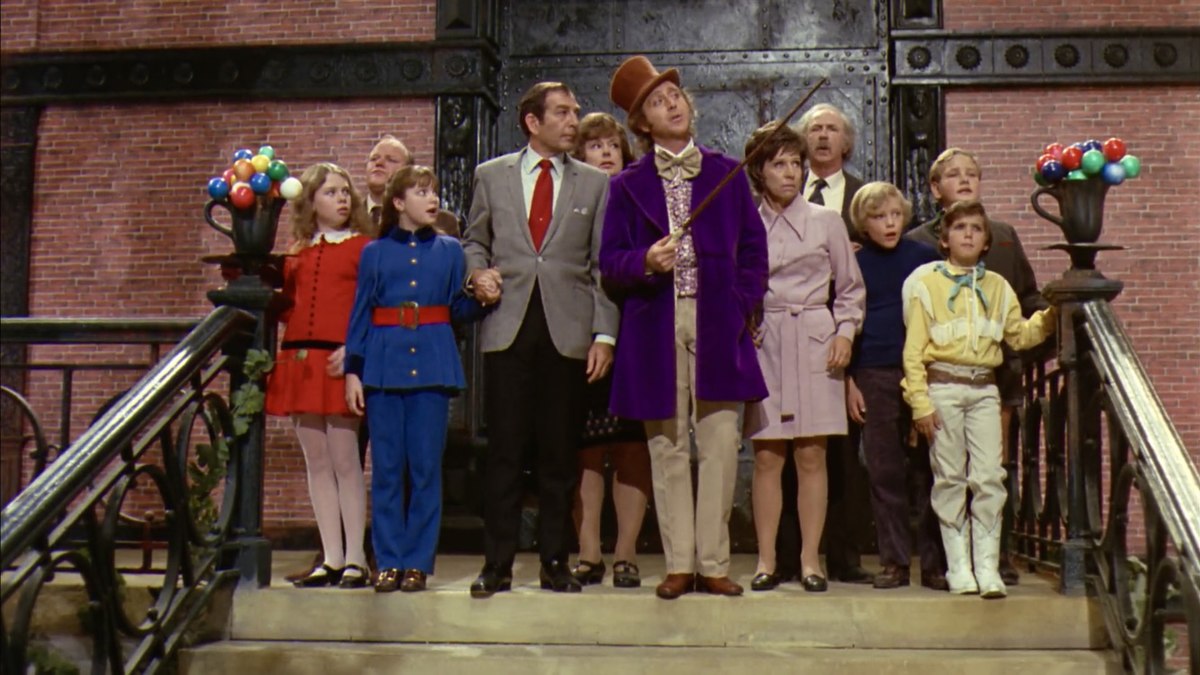
        Aside from giving the tour, his best moment is near the end when he accuses both Charlie and Grandpa Joe with stealing a new drink. Just his anger and the duo’s surprise that he’s basically mad beyond belief sell that he failed to find the new heir to his chocolate factory. That was actually the intention of the director since he didn’t want it to feel staged at all. Since he wanted the reaction from both Grandpa and the young boy to be real given the context of the story. 

3. The Chocolate Factory
        I got to talk about the factory, no review of the film can’t continue unless they spew poetics of how freaking cool the factory is. When the opening credits start and we see just how the chocolate are made give it the idea that it’s just a regular factory that’s owned by Hershey’s or something. After the kids go in, the factory is anything but normal. 
        Just like I brought up earlier, the Factory is representative of Hell. How else can you explain the tunnel scene with all the weird images popping up?  Okay, just hear me out. Both kids and adults are going through a test to be humble, yet their own hubris and vice get the better of them as they each become affected by the factory. And we never see the kids exit out the factory. Alright, I think that’s about enough of that. To me, everything inside the factory is so reality warping where it’s weird and hokey. 
        I’m glad that there’s never really an explanation as to how exactly Wonka created or invented the machines or candies. Everything is left up and has that child-centric imagination where the possibilities are endless. One thing that I notice is that the factory is an extension of Wonka, we never know if the whole factory is an act to have the kids be enraptured by the factory. Just like the man where he looks normal, but everything else is abnormal.  

4. Legacy
        The film didn’t do well initially when it came out. More so that it wasn’t publicly received very well. Ironically, Paramount didn’t renew their distribution rights, thus handing it over to Quaker Oats, who handed off to Warner Bros. It was actually during the 80s when the film had multiple viewings in television that it gained a new audience and reached that title of classic. Roald Dahl didn’t even like the movie, and negated a sequel being commissioned based on his sequel book. 
        My very first exposure to Wonka was when they had candies that had the Wonka brand of it. Ultimately, Tim Burton remade the film with Johnny Depp and rightly titled the adaptation. Cinematically speaking, this was my first exposure to the film before the original. In my opinion, it’s just ok. I never really understand the hate towards it since it’s a completely different adaptation, with someone who has that artistic aesthetic like Tim Burton helming it. Sometime this year, an origin movie about the owner is coming out. Why have a movie explain the background to an interesting character? I don’t know.  

5. Overall
        Willy Wonka and the Chocolate Factory is considered one of the best films of Roald Dahl’s work. It’s timeless after 50 years it came out. 


Saturday, August 5, 2023

Shrek Review

        To get things out of the way, I haven’t been as consistent as I have been with these reviews. You may have noticed that last week I didn’t review anything. That was mostly on me probably talking about the one of the best non-Disney animated films of the 90s two years ago. In all honesty, I didn’t thoroughly plan July with the films I wanted to talk about. With the excuses out of the way and trust me. This initiative isn’t going anywhere. Let’s at least wrap up my summer look with the animated film I think altered an industry. 

1. Unlikely Hero
        I think it comes to a shock and surprise to some people that Shrek isn’t entirely an original animated movie. For the few who actively follow children’s literature, it’s based on the book of the same name by the late author William Steig. I’ve investigated the book and the movie sort of follows the book. I’ll elaborate the one element that is pretty much one of the film’s defining aspect. As I dug deeper, this film was considered punishment at DreamWorks. 
        Apparently, whenever a select slew of animators were failing on their projects within the studio, such as not animating a specific shot. They were moved to the production of this movie. It was called being “Shreked”. In one way, I think this film from a developmental standpoint has that edge of cast-offs putting their best into it. Especially having the computer-generated images be so different that what came before with Pixar. 
        One more thing was that this film was supposed to have SNL alum Chris Farley. On YouTube, one moment was recorded when Donkey and Shrek were talking at night just after rescuing Princess Fiona. Hearing his voice and seeing the conceptualized scene is one of those moments where anyone can wonder just what if. He passed away during the movie’s production and they hired Mike Myers. Another SNL alum and who was a box office draw at the time with his Austin Powers films. 
        So after all that necessary, depending on who you ask, info done, let’s talk about the film. We follow the anti-social ogre named Shrek. After noticing his swamp is infested with characters from various fantasy stories, he goes to Lord Farquaad and makes a deal to rescue a princess to have his swamp back. There’s a level of comedy and brashness that makes Shrek so loveable. He’s just himself when he makes light of any danger that comes to him. 
        Him and Donkey are the main highlight of the film. I can only imagine where they producers nailed the casting of Eddie Murphy. Just him and Mike Myers have that chemistry where Shrek is annoyed but manages to put up with Donkey’s idiosyncrasies. Donkey isn’t grating in the least bit which makes him enjoyable. The constant back and forth between the two feels right since we believe that their sudden friendship feels authentic. 
        I love that depth that Shrek has as a character. For as much as he’s embittered, he wants to be accepted. He has that mentality that he is easily unlikable to everyone which justifies his actions. That moment when Donkey and Shrek are talking at night is I think my favorite scene. We get an understanding of where Shrek is coming from and just how Donkey assures him that he didn’t have any preconceived notion of him. It helps break that idea down the main character has to be handsome or good looking, but just about being accepted.
        Since we’re talking about the overarching theme, the movie is mostly about acceptance. At the start, we see that everyone is afraid of Shrek except Donkey. Especially more so when Farquaad is presented with the princesses and the Magic Mirror tries to warn him about Fiona’s secret. It destroys and moves away from that perfect idealized view of the perfect princess, the hero and really brings it home where Farquaad is a small turd. The scene when Shrek and Fiona are having fun with each other as they venture back highlights that. 
        I think at the time it was progressive where it tries to be the exact opposite of the standard Disney animated fantasy movie. The inclusivity of it is astonishing since it shows that anyone can be the hero. More so that as I mentioned before that the princess can be different than what we usually think of them. It’s even shown during the film and when Donkey sees Fiona’s other form and hilariously gets confused. 

2. Anti-Disney
        I might as well bring up that whole anti-Disney aspect that the film has going for itself. Either it was mandated from Jeffrey Katzenberg, who worked for Disney from the late 80s to the 90s. Or it was just something cheeky that DreamWorks thought they should put in as a proverbial middle finger to them. It’s abundantly clear that the movie is riffing on them. Right down to the fantasy characters that are being used. For the most part, they kept it classy by not giving the fantasy characters an ugly look to them. 
        More so that the film can be interpreted as an animated parody, poking fun at the usual story beats of the Disney movie. Like how in the beginning of the film, Shrek is reading the story about Fiona and just laughs it off. Ripping off a page and wiping his butt as he busts out of the outhouse. Compounding it how the initial rescue scene doesn’t go to plan and is just as hilarious as it was presented. 
        I think my favorite part of the middle finger moments is when both of our heroes arrive at Farquaad’s castle and experience the emptiness. Just them hearing the stock amusement music and just how the entire area is dead pokes fun at Disney’s various parks. Especially when the musical number featuring the robotic figures feels unreal and hilarious. 

3. Legacy
        Shrek was an absolute smash hit and made a profound impact in pop culture. It was a wise move that my parents took me and my brother to go watch it. Perhaps having no clue as to what everyone was going to get with the movie, it was worth it though. No one could’ve imagine that this film would start a franchise that grossed billions in total. I’ve only ever watched the first three films, the second is obviously the best one of the series. And it’s still going with the recent release of the Puss in Boots film from last year that was a surprise hit. 
        I really hope that the estate of William Steig received some sort of compensation as the film’s success generated interest in the character. For a film that was mostly advertised for kids, I’m surprised there was some moments for the adults. Watching it now with a more, I think, level-headed mind I noticed some cheeky stuff. Whether it was for the adults to spot it as something of a wink-wink as the kids were just lost in the animation might be intentional. 
        It's surprising to me that the film had for a little while a meme-moment on the internet. You had people constantly quote or write “Shrek is love, Shrek is life”. Now it wasn’t for deriding the movie in the least bit or even ironically but just celebrating it as something where acceptance and tolerance is needed. I think with Smash Mouth’s All-Star and their cover of “I’m a Believer” punctuated the memes. And the film won the inaugural Best Animated Film award at the time during that year’s Oscars, thought I should mention that. 

4. Overall
        Shrek is one of the most beloved animated movies of my generation that is still relevant today. 


Saturday, July 22, 2023

The Secret of N.I.M.H. Review

        The 80s in terms of animation had a massive shift. Disney had a brief period that encompassed that decade that has been commonly called the Dark Age. A moment in time when the animation studio was almost close to being dissolved. Additionally, animation was moving in a direction where the quality was downward trending and being cheap to make. One animator that was part of the Disney Animation crew left and formed his own independent studio. Don Bluth is the most important filmmaker in terms of cartoons and giving Disney a good competition. Here’s what I think of his feature debut. 

1. Don Bluth
        Just like Ralph Bakshi having a distinct voice, Don Bluth is the same with his animation style. Born in El Paso and living in Utah, he watched and inevitably worked at Disney as one of their animators. He had a hand in animating Sleeping Beauty and the animation hybrid Pete’s Dragon. He jumped from working with Disney and animating for television when he assisted with The Archie Show and Sabrina the Teenage Witch. 
        Disney’s The Fox and The Hound was Bluth’s last film with the studio. Having grown discontent with the artistic control that was shifting and the changing of the studio’s animation practice, Bluth decided to forge his own path and create his own studio. It would be a recurring thing where he would start a company but ultimately create a new one due to being cash strapped. While his movies were well received, it didn’t make enough box office revenue where his studio was sustainable. 
        One last tidbit is that he revolutionized video games. I was not aware that he had a hand in an Arcade game known as Dragon’s Lair. It was literally the most unorthodox game that came out during the days of Pac-Man and Donkey Kong. It didn’t rely on pixelated graphics like its arcade brethren but used animation. The way to control or win the game is to guide the hero using quick movements that were shown on the screen to advance. One wrong move and, well what do you expect? Nowadays, games use this method called a quick-time event. At the time, it was revolutionary.

2. Mrs. Brisby and the Rats of N.I.M.H.
        Based on the children’s book with the same premise and different name, even Disney was considering adapting the novel but turned it down. At the time, they had already released a mouse movie called The Rescuers. N.I.M.H. is the exact opposite of what Disney had produced at the time. Even more so, the fact that it was an independent feature that had a major studio distributing it says a lot. 
        We mostly follow the story of Mrs. Brisby, an intelligent mouse who tries to cure her sickened son. She’s thrown into a fantastic adventure where she interacts with other intelligent speaking animals and learns that they were products of NIMH. What I love about the movie is Brisby as a character. We first see her as a single mother raising her kids, one of them being under the weather with pneumonia. 
        She’s the rare example of a female protagonist that manages to be strong. It’s just her and her family that gives her the emotional baggage she has. At the start we see her getting medicine for her son who has pneumonia. A chance encounter with a crow named Jeremy starts her adventure to be an unlikely hero. When she’s with her family, Auntie Shrew helps her out with her kids. There’s one thing that I noticed that to me at least was different with other animated movies is that Auntie tells Brisby that she must grow up. It’s a recurring thing that we see what Brisby goes through, and she’s scared out of her mind. One thing that is the film’s best moment is her arc, from growing scared to inevitable being courageous. 
        Aside from her developmental growth, the movie is imbued with science and mysticism. We see moments when intelligent rats steal electricity from the farmer’s home to develop their own methods of energy. And from that point forward, we get to understand just who the rats are with their newly gifted intelligence. The whole dynamic has the science vs nature aspect to it since we see with Brisby that the rats have grown smart enough where they’re debating to either move or stay. 
        More so with we get an understanding as to who exactly NIMH is. I’ve dug around to find more info on the book and the author based his book on the studies of John Calhoun. Who studied on mice and rat dynamics when he worked for the National Institute of Mental Health. That explains what NIMH stands for in the movie and what’s interesting is that they are treated as a looming threat. Just scientists who give the animals some drug, for what purpose we don't know. 
        Speaking of threats, this film doesn’t hold anything back in terms of animation whenever there is something that endangers Brisby or the rats. The level of fear and unknown is the film’s other strong point. Like when Mrs. Brisby encounters a guard named Brutus and it gets real when the rat swings his spear at her. The film doesn’t shy away from the characters getting hurt. They bleed and near the end there’s a final fight that gets brutal for its time. 
        The moment between Brisby and a rat named Justin going into the farmer’s house might be the best moment when displaying Brisby’s fear. They have medicine to knock out the cat. Brisby is scared but Justin tells her that she must do it. This is the thing that is very rare for any animated film showing the emotional stakes that the main character is going through. The level of investment with this character is astounding since she’s being put through the ringer with everything going on. 

3. Legacy
        The film was a modest success, but I still think it’s one of the best animated films of the 80s. Given what was coming out before and during the time, it was game changing since it legitimately challenged Disney by being more mature. From there, Bluth got the attention from Steven Spielberg. It only made sense for an established director to try and dabble with animation. From there, this is around the time where both Bluth and Spielberg produced An American Tail and The Land Before Time. They were box-office hits and further cemented Bluth as an animator with a voice. 
        Unfortunately, I couldn’t find anything that delved into why Spielberg and Bluth parted ways. From the late 80s through the 90s, Bluth struggled and made films that were just middle of the road or just bad. The box office revenues shrunk to a considerable degree since the product didn’t reflect Bluth’s style. It wasn’t until he made a partnership with 20th Century Fox that he made the animated adaptation of Anastasia. From there, his career was over after his following film Titan A.E. bombed and effectively killed the animation studio. 
        For some inexplicable reason there’s a sequel to The Secret of N.I.M.H. that came out during the late 90s. Bluth had no involvement with it and it obviously shows. I’ve seen pieces of it in small batches and man, I just feel bad for the fans of the first movie be so incensed and offended that this is a sequel to a beloved film. It wouldn’t be his only film to be made into sequels, and I’m curious to know if he ever got residuals from them. 

4. Overall
        The Secret of N.I.M.H. is one of the best animated films of the 80s. Even rivalling whatever Disney put out at that time. 


Saturday, July 15, 2023

Wizards (1977) Review

        I’m back, talk about a big break. To be honest for talking films for this month, I had no idea what kind of movies to talk about. I ultimately settled on animated films that weren’t Disney, but it was the topic of what movie to start. Particularly animated films by Ralph Bakshi, I had wanted to talk about his feature debut. Unfortunately, I couldn’t find the movie on streaming not even for rent on Amazon Prime. So with that, here’s what I think about Ralph Bakshi’s Wizards.

1. Ralph Bakshi
        To get an understanding of the movie, we must talk about Ralph Bakshi. Not to inundate the whole review with a thorough lens but his background is interesting. Born from British occupied section of Palestine then emigrating to the United States, Bakshi got his start on television as an animator. He eventually advanced with his career and started his own company, doing various commercials and contracted for some shows. 
        His feature debut Fritz the Cat was based on the underground comic of the same name by artist/writer Robert Crumb. It was marketed as the first X-Rated animated film to be released. I’ve only seen snippets of the film in various places, but it’s mostly a parody of the social climate of what was happening in the US back in the 60s. It immediately made itself known that animation wasn’t just for kids but for adults as well. 
        Bakshi practically made a name for himself with his style that included making fun of the social commentary that was relevant at the time by using animals. Sometimes even using moments of rotoscope in an animated film. That means drawing on a strip film to be animated instead of just hand drawing it. He was a product of the times. His career spanned between the early 70s to the early 90s but I believe that he was the first instance of an animated director having a voice in his work. 

2. World of “Wizard”
        I specifically chose Wizards because the way the movie looked visually interesting to me. Seeing how the film was different than its animated counterparts also drew me in. With that, we see that the film takes place years after a nuclear war had nearly wiped out all of humanity. Earth is now inhabited by mythical creatures like fairies, dwarves, and elves as the new intelligent life. Although they are divided. 
        We follow Avatar and his group including a hybrid named Elinor and a warrior Weehawk as they travel to stop Avatar’s evil twin Blackwolf. It’s about as basic plot wise but the story is probably dense. Everything is fleshed out at the very start with the use of storyboard stills which looks like it came from an illustrated book. The way its used is gives us a break from the action and to detail what’s happening, since the film’s budget was only around 2 million. 
        The characters are interesting, especially Avatar. He’s the main character and throughout the movie, nothing goes right with everything around him. We see him being a gifted wizard who trains his fairy friend. What I like about Avatar is that he usually doesn’t fight back when he and his group are confronted by danger. Only ever when he conjure up something as a last resort. I was surprised to learn that Mark Hamill appeared and it was his first film literally prior to Star Wars. 
        The animation is the main highlight. Something about Bakshi’s style is sort of new to me since I understand that I’m being repetitive, is different. No one in their right state of mind would ever put anything violent in an animated movie like having a character get shot and have exit wounds to show for it. Especially how it’s not in an exploitive sense where a whole limb gets blown open.
        To me, its interesting to have a world that is mostly dominated by mythical creatures and imbue it with technology. In the beginning, it’s made clear that technology is frowned upon among the mythical creatures. All the while Blackwolf uses a projector for psychological warfare. When you watch it, there’s loads of Nazi stuff. Swastikas galore, although its used to highlight the main villain and his army. 
        I think the main thing with that use of propaganda is that it’s the film’s theme. The villain uses the propaganda to motivate his army since their incompetent. Additionally, they use the old war footage to stun the opposing soldiers since they can’t comprehend it. Conversely, when the heroes are captured and they’re trying to get free, the fairy king believes that the main heroes are the villains since they heard it through Blackwolf. 
        If there is one thing that I find curious is that the character on the poster isn’t the main character. One would think that it is, but Necron 99 does start out as a goon for the main bad guy. I think it’s genius since the character is a robot and has that unorthodox look of what we think a robot could be. Way back during my college years, I saw that poster used as another poster during the University’s student run convention. 

3. Overall
        With Ralph Bakshi, you’re either going to love or hate his style. With Wizards, it was interesting since it’s a different kind of animated movie to come out. Especially at a time when Disney owned that area. 


Overlord Review

          Happy Halloween! As always, it’s something to review a series of movies from different decades and see just how much the genre has...